

People who have lived through trauma often develop a set of quiet, practical survival skills they never expected to grow. Some don’t even realize it. These are not mystical abilities or “silver linings.” They’re simply a human’s way of increasing the odds of survival. After all, we’ve known danger — up close and very personal. This is how the brain adapts to the environment. We do it all the time. Have you ever moved into an apartment where you soon “tuned out” a noisy refridgerator or the sound of a nearby railroad? You’ve probably learned the layout of an unfamiliar setting like a large hospital, factory or new community. These are all examples of “neuroplasticity” or how the brain adapts to the environment. Brains are not static.

After trauma neuroplasticity kicks in, too. Therapists may refer to this as “hypervigilance.” Some survivors can read a room the moment they walk into it. Others sense emotional undercurrents of tension between two people or recognize an argument recently took place that has already ended. And some — especially those who spend time in nature — begin to notice subtle things: shifts in air pressure, sudden silence, or the heaviness of a landscape that changes without warning. None of this is obvious to them. Nor is it magic. It’s biology sharpened by necessity.
Before sharing two contrasting examples from my own life, I want to briefly explain the biology behind this — how trauma can change our brain’s functioning and perception.
How Trauma Changes Our Brain Functioning
Ever heard of the “limbic system”? It’s not a single structure but a cluster of small, interconnected ones deep in the brain, roughly level with the eyes. It plays a major role in regulating emotions, motivation, long-term memory, and even our sense of smell. Here’s the part that matters for trauma survivors: the limbic system is also heavily involved in how we detect and respond to threat. So it follows, then, that trauma changes the limbic system in survivors. These have been noticed in the MRIs of soldiers, abused children and rape survivors.
When someone has gone through trauma, the limbic system becomes quicker to activate our survival mode. It releases powerful brain chemicals that bypass deliberate thinking. This means we react before we analyze. We move before we plan. We get away before we weigh our options. Only later do we stop and analyze the situation.
With that in mind, here are two moments when this system shaped my perception in very different ways.
Ambient Stillness (Safe Stillness)

Recently, I took a walk in the forest behind a hotel where I was staying on land owned by the Jamestown S’Klallam Indian Nation. I’d been indoors all day and wanted fresh air and a chance to take photographs of the ferns and cedars. It was late afternoon in November, the light fading under heavy overcast. Greens had muted into the color photographers call “blue hour,” that brief, dim transition before nightfall.
Even deep under the tree canopy, I could smell cooking from the hotel (which meant every animal in the forest could too). Then something unusual happened.
Everything abruptly went still.
No birds. No wind. No rustling leaves. No movement at all. A suspended quiet settled over the forest, like stepping into a 360-degree still photograph. I suddenly felt small, relative to the towering cedars, but not in danger. Alert, but not alarmed. The air felt heavier, as though the forest itself was holding its breath.
I didn’t feel threatened or even observed. It felt collective — as if the entire ecosystem pressed pause at the same moment. Animals likely froze mid-step. They weren’t reacting to me; they were reacting to each other. This is “ambient stillness” or “safe stillness.” It often happens when a large predator, likely a cougar in this case, moves through the area.
After taking a few more photographs, I turned back because daylight was fading, mist was increasing, and the terrain was rising ahead of me — not because I was afraid. My body simply understood something about the landscape before my mind caught up. That’s one kind of knowing.
Danger Stillness
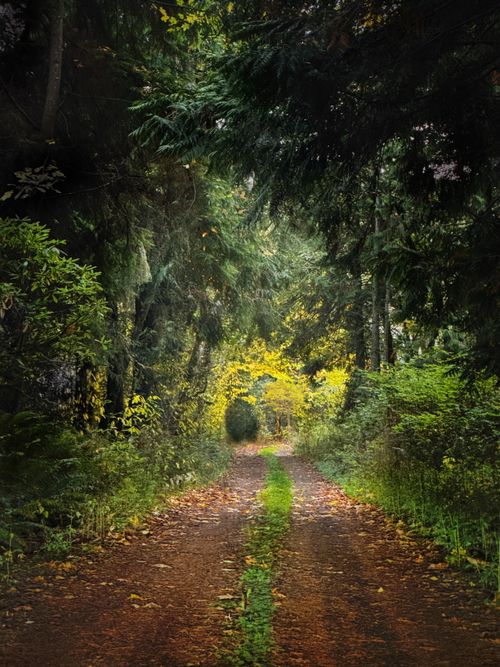
The second kind of knowing is very different. This moment happened years ago on a dense rainforest switchback road. I was out photographing when I noticed a narrow dirt road to my left, roughly the width of a driveway. No fences, no signs, no mailboxes — no warnings to suggest this was off-limits.
At first, nothing felt wrong. My mind was on the light, the trees, and where I might set up my tripod. But as I slowly drove up the narrowing path, something shifted. Dramatically. It felt as though the environment itself was pushing me back.
Like the first example, there was no sound. No smell. No figures in the trees. No dogs, no structures, no indicators of danger. But unlike the ffirst example, there was a sudden, insistent clarity: Turn around. The farther I drove, the stronger that message became: Turn around! NOW!
This wasn’t the ambient, collective pause of the hotel woods. It was directional. Personal. Threatening. I reversed the car, and the pressure eased, disappearing entirely once I reached the main asphalt road below. I didn’t understand it at the time — I just obeyed without analysis. I left without really knowing why.
Months later, I learned a cartel-run meth operation had been active in that exact area.
This is “danger stillness.” Not the forest holding its breath in response to natural predators, but human unpredictability radiating outward in ways the body can sense long before the conscious mind identifies a threat. Again: not magic — just a survival system working exactly as designed.
Trauma survivors often develop these quiet skills because we had to. Our bodies learned to scan for subtle cues in tone, tension, air, posture, and atmosphere long before we had words for any of it. We read environmental shifts — emotional and literal — faster than other people realize something is happening.
These skills aren’t glamorous, and they aren’t gifts. They are simply the long-term hypervigilance of survival. But later in life, they can become quietly useful.
If you’ve lived through trauma and ever feel the world go still — the wrong kind of still — trust yourself.
If you feel an inner “leave now” obey it.
If the forest feels like a still painting instead of a forest, pay attention.
If your skin prickles or a quiet voice says, No. Not this way, listen.
If you sense it’s not safe to get into an elevator with a particular stranger, don’t.
If you feel uncomfotable in the presence of a stranger it’s okay to be assertive. You do not have to be “nice.”
You’re not overreacting. You’re not superstitious. You’re not imagining things. You’re reading the world with a refined nervous system that is tuned to notice danger even before it has a name.
It’s not a blessing.
It’s not a reward.
It’s simply your brain adapting and it is a part of you now — quiet, steady, earned through endurance, and available when you need it most.
For readers who want to learn more about intuition and the body’s early-warning system, a very readable resource is The Gift of Fear by Gavin deBecker. His work explains why so many survivors accurately sense danger long before they can say why – and he does so in a way that is practical.


